 Skip to main content

MicroPilot Drone Testing Services

Send us your drone. We'll give you results.
With over 32 years of experience and involvement in more than 2,000 UAV projects, MicroPilot understands how drones fail and how to make them more reliable. Whether testing a complete drone, an individual component, or a subsystem, our comprehensive testing services go beyond identifying problems to provide practical recommendations for improving performance, reliability, and design. There’s no need for expensive staff travel or investment in specialized test equipment. Simply ship us your drone or components, and we’ll put our expertise, test equipment, and facilities to work for you.

GNSS Performance Testing
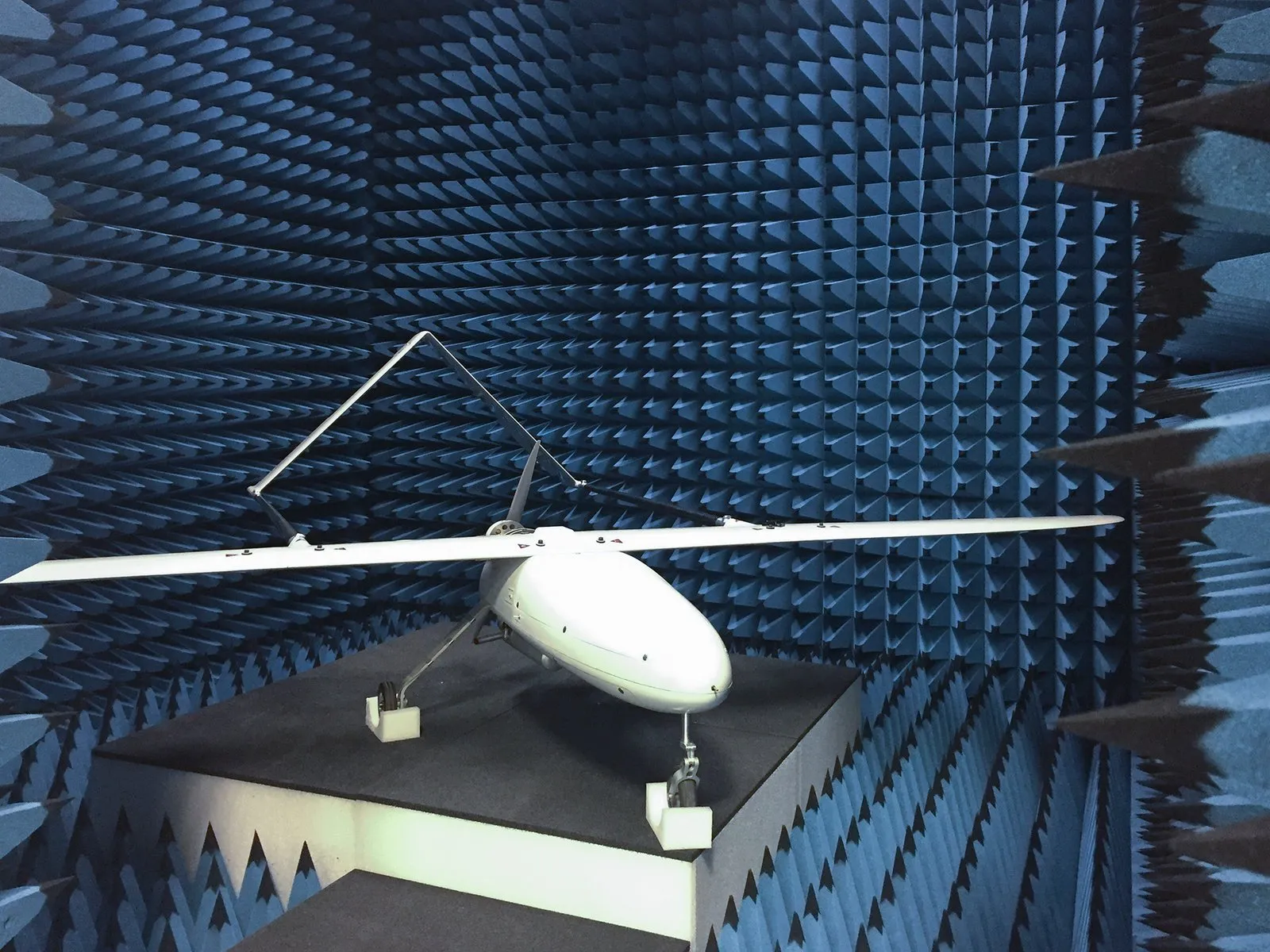
The GNSS receiver is one of the most critical sensors on a drone, providing position, velocity, and timing information essential to reliable autonomous flight. Using a GNSS simulator to transmit a precisely controlled signal into our anechoic chamber, we can measure your drone’s end-to-end GNSS reception performance, from antenna to receiver. Testing the aircraft in multiple orientations helps identify antenna placement or installation issues that could degrade GNSS performance. The same setup can also detect interference generated by onboard electronics, including motors, power supplies, and communication systems, and quantify its effect on GNSS reception.
HALT Testing
Identify design weaknesses before they become costly field failures. MicroPilot’s Highly Accelerated Life Testing (HALT) exposes complete UAVs or individual components to extreme temperatures, six-axis vibration and combined stresses to uncover reliability problems before your customers do. HALT is also a valuable tool for evaluating and qualifying suppliers and their components. Our HALT equipment generates vibration levels up to 100 Grms at frequencies up to 10 kHz.

EMC Emissions Pre-Testing
Identify and quantify unwanted electromagnetic emissions from your drone’s onboard electronics. Beyond regulatory compliance, these emissions can interfere with sensitive onboard receivers, degrading datalink range and GNSS performance. Because received signal power decreases with the square of distance, relatively small increases in onboard emissions can result in significant reductions in usable datalink range. Identifying and reducing these onboard emissions can therefore produce substantial improvements in datalink performance.
Cold Weather Flight Testing
Flight testing in the Arctic is an expensive, time-consuming and inconvenient exercise. During the winter, MicroPilot’s test site can see temperatures as cold as -40°C. We can evaluate your drone’s performance in real-world, near-arctic winter conditions. Assess cold-weather battery performance, flight characteristics and system reliability at low temperatures.

Vibration Characterization
A drone is exposed to vibration from motors, propellers, engines, aerodynamic forces, and other sources, but vibration experienced by individual components can be significantly amplified by structural resonances. MicroPilot’s HALT chamber provides broadband vibration excitation up to 10 kHz, enabling evaluation of complete drones, subsystems, and individual components for resonances, vibration amplification, and mechanical weaknesses. Instrumenting different locations on the drone can help identify vibration transmission paths and evaluate the effectiveness of vibration isolation, providing valuable information for improving the mechanical design and installation of sensitive avionics.
